Friday, 23 August 2024


Do you have a glory story?


As I was reading a book by one of my favourite authors recently, I came across a phrase that keeps coming to my mind over and over. Glory story.

Not really self-explanatory and a little confusing, that is, until you realise what it’s all about.

For those of you who read my blog regularly, firstly, thank you. I am so blessed that God chooses to use me to be a source of encouragement to others. Secondly, you’ll know, through what I’ve shared, that six years ago, I was a different person than I am today.

For 6 months I fought an internal battle. An unexplained battle with depression, anxiety and panic attacks that literally took my breath away, threatening to take me out completely. It had made itself at home and nothing I could do seemed to shake it. Everything I tried failed.

But while I was being pounded by waves of fear, while I struggled through days where I didn’t want to get out of bed, while I neglected friendships and often tried to put on a brave face hoping others wouldn’t notice, God was working. God was weaving threads of strength through my pain.

God was writing my glory story.

I began to feel as Job did when he said this.

Job 42:5 KJV - I have heard of thee by the hearing of the ear: but now mine eye seeth thee.

Through my trial, I began to really see God. To learn of his ways. To understand the depth of his character and I began to get a greater sense of awe for his power and might. I began to really get to know God.

And as I gained strength day by day, I began to beg God, “Don’t let it be for nothing, God. Use me. Redeem it. And turn my trial into a glory story. Use my glory story to benefit someone else.”

Just as the underside of a tapestry is all knots and imperfections, so that the top can be intricately beautiful to behold, I realised God was, in his love, weaving some hard lessons through troubles so that I could become something more lovely. Something that showed the glory of God.

I determined that when, and not if, when I got through it, I would give him the glory. Not the medication, not the worship songs, not the counsel of friends, although they were a great comfort to my soul, but God. God would get the glory.

He was writing my glory story, and I wanted to make sure I shared it.

I began to realise that perhaps God was writing a glory story in my life for someone else’s benefit. And he had chosen me to go through the pain in order that someone else would be blessed, helped and encouraged by the experience and the lessons I had learned in my time of trial.

Even tonight, as I sit here writing this, tears come to my eyes as I marvel at God’s goodness to me. I cry tears of joy and happiness. I am so overwhelmed by the love of God and the fact that he chose me to not only go through something painful so that I could be a comfort to others, but also that he chose to do a purifying work in my heart and life, to make me more like him.

At the time it felt like a cruel cross that I had to bear. But God used it to purify me and help draw me closer to him. He developed in me a love for him and his Word. He gave me a hunger and thirst for the Words of Scripture and a desire to study and grow in my relationship with him.

He helped me to see the needs of others with a heart of compassion. He began to stir my heart to be sensitive to those around me and reach out and love others that needed a friend. He brought a peace to my heart that I had never known and a peace that could be a testimony to others of God’s goodness.

Are you struggling through something today? Are you inundated with trials, and you feel like they will never end? Could it be that God has plans to use you to help someone else?

As I get older, I am finding more and more that the pain in my life and the struggles I’ve been through have made me more effective in ministering to others.

When I speak of trusting God fully, it sounds trite, until I share some of the ways I have had to trust him in the shake ups in my life.

When I speak of God’s joy, it doesn’t sound convincing until I share some of the depths I’ve been to, and the lengths God has gone to pull me up and put a smile on my face because of who he is.

When I speak of a peace that passes understanding, people don’t relate until I share my pain of depression and how God brought peace to my soul through his Word.

The more I experience suffering, the more access I seem to have to others in need. The more I am able to empathize, come alongside and say, “I know how you feel. I’ve been there. And I can tell you how to get back up.”

God has used trials and troubles to mold me in ways that nothing else could.

I would be doing you an injustice if I didn’t share this passage of scripture right here.

2 Corinthians 1:3-4 KJV - Blessed be God, even the Father of our Lord Jesus Christ, the Father of mercies, and the God of all comfort; Who comforteth us in all our tribulation, that we may be able to comfort them which are in any trouble, by the comfort wherewith we ourselves are comforted of God.

When I was going through my darkest time, I had to accept God’s comfort. I had to let him work in my life, ministering to me so that I could then minister to others and pass that comfort on to someone else. Then, and only then, could God get his glory story.

It really is up to us whether or not God will get the glory. We can choose to dissolve into a heap in a grand pity party or we can choose to turn it into a glory story. It’s our choice.

Can I encourage you to not let your trial be for nothing. Let God use it. Let him turn it into something beautiful. Don’t let others see the knots and imperfections, the discontent and grumblings. Let them see something beautiful. Recite God’s goodness often. Tell others regularly of what God is doing in your life. Share with them the messes God has made clean.

As you get into the practice of telling others of God’s goodness in spite of the trials you face, you are revising and updating your glory story, and it becomes your testimony. Your testimony of God’s might and power, love and grace.

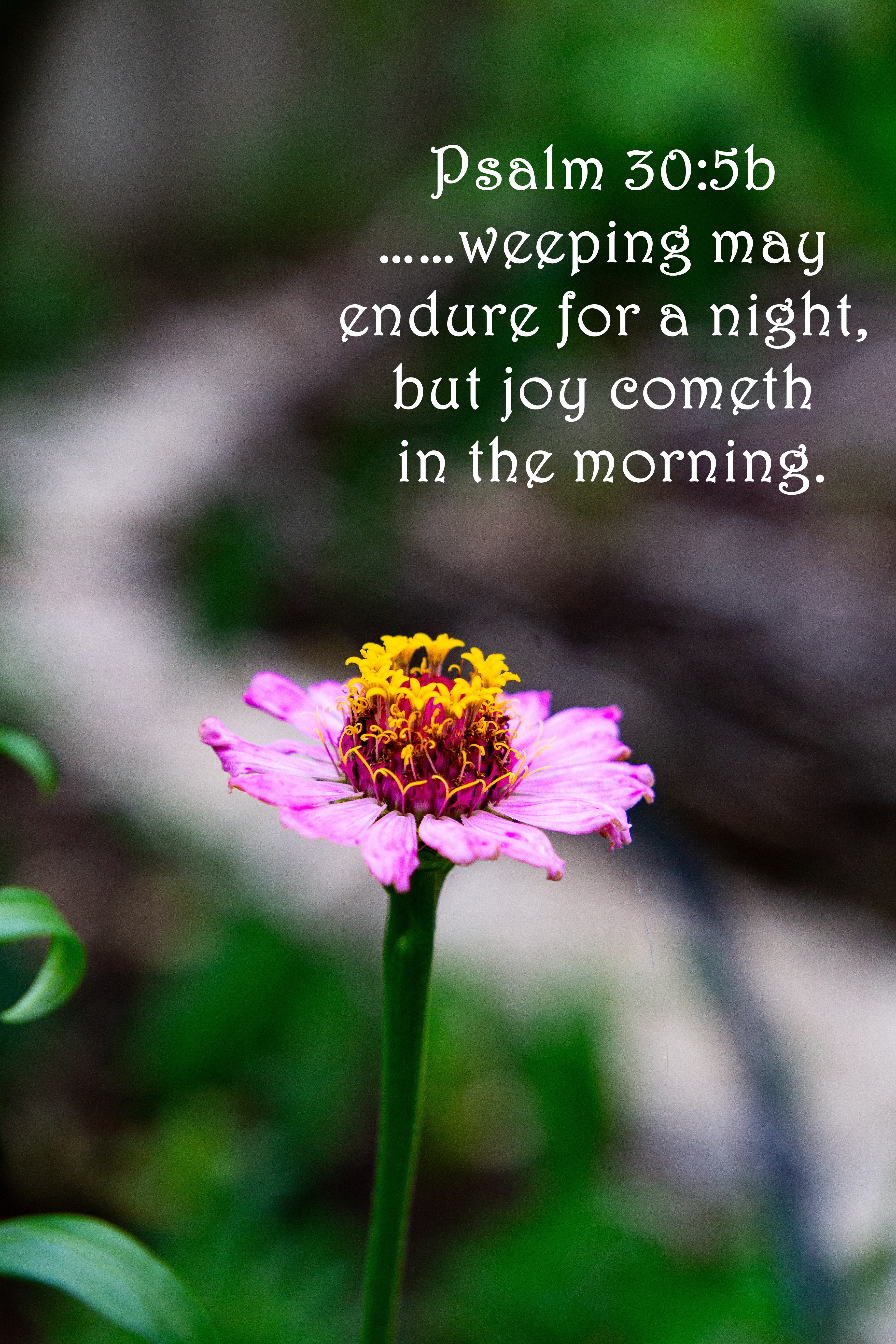
I love the promise that David sings in Psalm 30 verse 5 ……weeping may endure for a night, but joy cometh in the morning.

I claim this as a promise that although the night is dark and sometimes lingers for a long while, the morning eventually comes, the sun rises, the clouds roll away, the skies clear and joy comes! The desert of suffering is not forever.

David knew, that although he faced and would face many difficulties in life, they would each eventually come to an end. Joy would come in the morning. He kept his focus on Christ and what he knew of him.

He was then able to say, “Thou hast turned for me my mourning into dancing: thou hast put off my sackcloth, and girded me with gladness; To the end that my glory may sing praise to thee, and not be silent. O LORD my God, I will give thanks unto thee for ever.” Psalm 30:11-12

Let God turn your mourning into dancing and let him clothe you with gladness. Give him all the glory and praise and don’t be silent about it.

You never know what sharing your glory story might do for someone else.

You might have to go through the fire, in order know how to pull someone else out.

Let God use you.

Let him write your glory story.


Thursday, 22 August 2024


Lay. Lift. Lean. Look.


Often, as I listen to a sermon or podcast while going about my household chores, I will hear something that causes me to pause and hastily scribble down some notes on a scrap of paper, to add to my ever-growing pile that sits beside my computer.

These can be anything ranging from things that I want to study further to quotes worth remembering or a passage of scripture that I needed reminding of.

I encourage you to take the time to do this when you can. We can get caught up listening to a good sermon, soaking it all in, and then forget all about it later. If there is something that catches your attention, take the time to jot down the points or scripture references and then look into them further when you have your quiet time. I have learnt so many interesting things through doing this, as it encourages me to dig deeper and gain a better understanding of what I’m reading or hearing, so as to apply it to my life and grow in my Christian walk.

All this to say, on one of my scraps of paper by my desk, I had jotted down some notes on a particular Psalm but hadn’t had a chance to read it through again. And then, this past Sunday, I was encouraged and excited to hear a sermon on this very Psalm, spurring me on to sitting down and writing something on this subject.

But before I get to it, I want to mention a notable verse found in the book of Romans.

Romans 15:4 KJV - For whatsoever things were written aforetime were written for our learning, that we through patience and comfort of the scriptures might have hope.

This verse tells us that the things written in the Word of God are for our learning. They are not just an interesting collection of stories and quotable verses to put on our coffee mugs and walls, but they are for our learning. The word for learning here is translated as doctrine or teaching in other places in scripture.

So, the Word of God is meant to teach us and comfort us so that not only will we be taught the difference between right and wrong, but also that we might have hope. The hope that Christ brings.

I love the teachings of an old preacher from years gone by, by the name of Vance Havner. One of my favourite quotes is this: “I have come to comfort the afflicted and afflict the comfortable.”

Sometimes when God impresses something upon my heart to write about, it is not comfortable. It is confronting. It stirs up the nest. It afflicts the comfortable.

But in this particular Psalm I see comfort. Comfort for the afflicted.

If today you feel afflicted, pressed down, burdened, abandoned and alone, then this is the Psalm for you. Although it’s not clear words of comfort as in some of the other Psalms, in reading between the lines, you’ll find encouragement.

Let’s read it together.

Psalm 13:1-6

How long wilt thou forget me, O LORD? for ever? how long wilt thou hide thy face from me?

 How long shall I take counsel in my soul, having sorrow in my heart daily? how long shall mine enemy be exalted over me?

Consider and hear me, O LORD my God: lighten mine eyes, lest I sleep the sleep of death;

Lest mine enemy say, I have prevailed against him; and those that trouble me rejoice when I am moved.

 But I have trusted in thy mercy; my heart shall rejoice in thy salvation.

 I will sing unto the LORD, because he hath dealt bountifully with me.

As I have mentioned before, in many of the Psalms, we see a progression in the life of King David.

Often, we see him on his face in pity. And then we see him on his knees in prayer and lastly, on his feet in praise!

Pity. Prayer. Praise.

What a beautiful progression.

Psalm 13 is no different.

In verses 1 and 2, we see David in sorrow. We see him asking God, “How long?”. Interestingly enough, that particular phrase is mentioned 61 times in the Bible. Sometimes it is God asking his people how long they will strive against him and at other times it is the cry of a broken heart asking God how long their particular trial will last.

In this Psalm, we see David feeling abandoned. He feels forgotten. He feels that God no longer sees him or cares for him.

Did you notice I said “feels”? Yes, our feelings and emotions are a gift from God, but they are often deceiving. We can’t always trust them. He only “felt” abandoned, but that was not the reality. God was still there. God was still working. God did still care.

Bear with me as I explain some things in this Psalm and then I will get to the practical application.

In the first 2 verses David is very sorrowful. He is hurt. He is looking inward, focusing on what he feels and his low state. But he is not backward in pouring out his complaint to God.

Did you know that it’s perfectly alright to pour out your complaint to God? Did you know that God is okay with that? He wants you to tell him what’s bothering you. He wants you to share with him the hurting places in your life. He is your safe place. You can be vulnerable with him. He cares. He listens. He understands.

And so, in the first 2 verses, we see David on his face in pity. Step one.

In the next 2 verses, we see a slight change. We read of David’s prayer. Here we see him crying out to God in an act of supplication. He asks God to “consider” him, to regard him, to pay attention to him, to look upon him with favour.

He realises his enemies are too strong for him. He is completely overwhelmed.

I can tell you that there have been many times that I have felt completely and utterly overwhelmed by my circumstances or my emotions. I have felt abandoned by God. Alone. But God’s promises have always held true. God was always there. Patiently waiting for my cry. Longing to hear my voice call out to him so he could answer in ways I couldn’t even imagine.

And so, David moves onto step two. We find him on his knees in prayer.

As we move into verses 5 and 6, we begin to see David’s song. He reminds himself of what he knows of God. He trusts in his mercy and then his heart begins to rejoice.

He realises that God is good, and God is merciful. He rejoices that God has dealt bountifully with him. He sees the salvation of the Lord. And because of these things, he begins to sing.

David set aside his circumstances, he took his eyes off them, he turned from an inward focus to an upward focus and placed his gaze upon Christ. He centred his attention on the God of his salvation. His rock. His fortress. His strong tower.

And so, with these last 2 verses, David moves onto step three. He is on his feet in praise!

Often, we find it hard to come to the place of worship and the words of praise are slow to come to our lips. But if we will just put aside how we feel and make the choice to offer a sacrifice of praise to God because he is worthy, we will find that before we know it our foot is tapping, our lips are mouthing words of praise and there is a song in our hearts and a lift in our spirit.

When you take inventory of all God has done in your life and the blessings he so abundantly pours out, you will begin to rejoice, and God will put a song on your lips and in your heart.

So, let’s get practical.

What do you do when your life comes crashing down? What do you do when you get that unwanted diagnosis, or you can’t cope with the circumstances you find yourself in and you feel overwhelmed, and the waves are crashing in?

You take note of those that have gone before, and you learn from the Word of God.

Like David, you lay out how you feel. Get honest with God. Pour out your complaint to him. Don’t hold back. He can handle it. There’s no need to hide anything from him. Tell him just how you feel.

Now, this won’t solve your problem, but it will help.

Secondly, you lift up what you need to God. David asked for strength against his enemies. Tell God what it is you need. Tell him just what you desire. Be specific.

Thirdly, you lean into what you know.

David knew down deep in his heart that God was a God of mercy. He knew that God could be trusted.

Remind yourself of what you know about God. Think about his characteristics. This is why it’s so important to be in the Word of God daily. The Bible is a book about God and the only way you will get to know him is by soaking in the Word.

Press into all you know of God and hold on to that. Look to him.

And fourthly, look to Jesus and send up a song of praise to God, thanking him for all he’s done or will do in your life.

Don’t stop at praising him for past victories, praise him for the future ones as well!

There should be no end to our praise songs.

If you start on your face in pity, then crawl to your knees in prayer and jump to your feet in praise.

Don’t let your circumstances steal your joy, cry out to God and watch him work!

* Lay out how you feel

* Lift up what you need

* Lean into what you know

* Look to Jesus and send up a song of praise


Psalm 40:3, 5 KJV - And he hath put a new song in my mouth, even praise unto our God: many shall see it, and fear, and shall trust in the LORD. ... Many, O LORD my God, are thy wonderful works which thou hast done, and thy thoughts which are to us-ward: they cannot be reckoned up in order unto thee: if I would declare and speak of them, they are more than can be numbered.


Tuesday, 20 August 2024


Did you forget to get dressed?


Every evening, before I go to bed, I lay out the clothes I am planning to wear the next day. I do this for a couple of reasons. One is that most days I wake before the sun has risen, and so, instead of blinding myself by turning on the light when I’m not quite ready for that yet, I am able to get dressed easily as I don’t have to search for anything.

Another reason is that I like to be prepared the night before for my day ahead. I find that when I am organized beforehand, my morning schedule goes a lot smoother. Kettle filled. Travel mug at the ready. Quiet time Bible study materials laid out. Shoes, hat, keys, wallet, pen etc on the counter and water bottle ready to be filled.

Now, to some of you, this may seem excessive, but it’s the way I like it. It works for me and so I do it.

My husband, on the other hand, is not so inclined. His way of getting ready is vastly different to mine, and yet it works for him.

So, where am I going with all this boring, personal stuff?

Every morning, or the night before, we give some thought as to what we are going to wear for the day. We think about what we'll be doing that day, and it determines what clothes we'll wear.


Is it a workday? Is it a church day? Is it a cold day? A hot day? Will we be getting dirty? Will we be sitting in an office? Will we be meeting with a friend for coffee? Our mind runs those scenarios over in our heads, and we plan accordingly.


But how often do we get up and “get dressed spiritually”? Do we rise every morning and plan what to wear spiritually?


Over the past couple of weeks, I have been studying in preparation for an upcoming series I will be teaching in our Ladies Bible Study, on the subject of the Armour of God.

When the topic was first suggested to me, I thought that maybe it was too overdone and would have a lullaby effect on the listeners, but after praying about it, I really felt it was something that was needed and there was a LOT that I didn’t really understand about it and I was keen to do some digging in order to gain a better understanding and grow in my Christian walk.

Now, I don’t have the space here to go into all I have been studying, but something I had written a few years back came to mind and I wanted to share it in light of the thoughts rattling round in my brain. It is only a tiny portion of the iceberg that lies beneath, and I encourage you to do some in depth study on your own.

Take a look at the passage in Ephesians and read what Paul wrote to the people of Ephesus, remembering that what he wrote then, is just as applicable to us now. Don’t skip any verses just because of familiarity of the passage.

Ephesians 6:10-18 - Finally, my brethren, be strong in the Lord, and in the power of his might. Put on the whole armour of God, that ye may be able to stand against the wiles of the devil. For we wrestle not against flesh and blood, but against principalities, against powers, against the rulers of the darkness of this world, against spiritual wickedness in high places. Wherefore take unto you the whole armour of God, that ye may be able to withstand in the evil day, and having done all, to stand. Stand therefore, having your loins girt about with truth, and having on the breastplate of righteousness; And your feet shod with the preparation of the gospel of peace; Above all, taking the shield of faith, wherewith ye shall be able to quench all the fiery darts of the wicked. And take the helmet of salvation, and the sword of the Spirit, which is the word of God: Praying always with all prayer and supplication in the Spirit, and watching thereunto with all perseverance and supplication for all saints;

We read in this passage about the battle clothes God wants us to wear.

As believers, we have access to incredible power, but also a great responsibility to learn how to put on and how to use the armour of God.

The choice we have as Christians, is not whether we’ll be a Christian civilian or a Christian soldier, but whether we’ll be a prepared Christian soldier or an unprepared one.

Paul gives clear instructions as to what to wear spiritually, what it does and how to use it.

We would never, even on our most brain-dead days, get up to start our day, without stopping to get dressed. No! We put at least a little bit of effort into clothing ourselves and being prepared for the day by what we choose to wear.


Why then, do we neglect to clothe ourselves spiritually? Why do we think we can make it through the day spiritually naked!


Some people think they can get by with a spiritual clothing once a week. On Sunday, they soak up the Word, read and pray, then for the rest of the week, they get about without their armour (spiritual clothes) on. And yet, they take care to get dressed physically each and every day.


The Bible clearly tells us why it's important to be clothed with His armour. We will be able to “stand against the wiles of the devil”. (Ephesians 6:11) His cunningness, his trickery and his deceit.


The Devil is very real. Don’t overestimate his abilities, but don’t underestimate him either.


The Bible tells us that if we put on the whole armour of God, not some, but ALL, we will “be able to withstand in the evil day”. (Ephesians 6:13).


I don't know about you, but I feel like we're living in the 'evil day'. Unless you live under a rock (like my 12th grade geography teacher thought of me because we didn't have a television), or you are in denial about the wickedness in the world today, you too know that we live in evil days. All the more reason to put on God's armour. Satan is just as active today as he was back in Paul’s day.


The Bible also tells us in verse 16 that we'll be able to “quench all the fiery darts of the wicked”. I know I don't want to take on a fiery dart without some protection.


So often we're guilty of taking care of the physical and neglecting the spiritual. We get dressed physically, but we forget to get dressed spiritually!


Paul didn’t say, “Bring the armour of God along with you on the off chance that you might need it.” Rather, he said, “You will need it: so, PUT IT ON!”


He knew that our enemy, the Devil, is out to get us. He is a liar, a deceiver, a tempter, an accuser, a slanderer.


The Devil knows that once you are a child of God, he cannot take away your eternal destiny. It’s too late for that. He also knows that he has been defeated already and his fate is sealed. And so, the best he can do, is to make your time on earth unproductive, full of fear and discouragement until you are unable to live freely and fully. He wants to render you ineffective in God’s work.


One of my sisters used to tell me in my teenage years, that it looked like I'd rolled around in my drawer and climbed out (due to my wrinkled state and a hippie phase I was going through at the time).


Well, it's not enough to 'roll around in the drawer' of God's Word, metaphorically speaking, and expect to come out with your armour on. You can't expect to be clothed right if all you do is read your Bible on Sunday, and maybe a little verse along with a nice short devotional every other day.


As we read our Bibles and study them, applying what we learn in obedience and couple it with prayer, allowing God to shape every aspect of our lives, we begin to be clothed in his armour. The battle we face is not an earthly one, and the enemy fighting us is a powerful foe, so we need supernatural power. God’s power and God’s armoury.


As we believe God’s truth and hide it in our hearts, we have it there ready for the enemy’s attack. As we arm ourselves with God’s spiritual clothing, we protect ourselves for when the battle heats up. We are prepared and ready. Dressed for war!


Just as we understand the need for getting dressed in our physical attire every day, we need to see the importance of getting dressed for the spiritual battle that is being waged against us by someone who hates God, hates us and seeks only to destroy us and our reputation.


We need to be ready. Alert. Watchful. And dressed appropriately.


1 Peter 5:8 KJV - Be sober, be vigilant; because your adversary the devil, as a roaring lion, walketh about, seeking whom he may devour:


O, church arise and put your armour on
Hear the call of Christ our captain
For now the weak can say that they are strong
In the strength that God has given


Monday, 12 August 2024


Can you trust His Word? 

Yes, you can!


Over the past couple of years, I have become a more serious student of God’s Word than ever before and something that I have begun to find of utmost importance in studying the Bible, is the need for understanding not only the context of a verse or passage, but also the culture of the time of its writing and the correct meaning of the words used.


If you take the time to listen to conversations around you on a daily basis, you will notice the differences in the usage of words used today as opposed to how they were used in years gone by.


I am often confused by words or phrases I hear from the younger generation and frequently have to ask what they mean.


This only highlights the fact that words and their usage change over time. Not only do some words drop out of use altogether, but new words come into being and also, words that we use commonly take on new definitions or lose their old definitions.


A word or phrase that meant one thing a few years ago may now mean something entirely different. And because of this, it often impacts how we understand older English writings without our even realizing it.


And our KJV Bible is no exception.


I think we often read our Bibles with our modern mindset, forgetting the culture and time it was written in. I know that many translators have tried to ‘modernize’ the Bible to make it easier to understand, but I don’t think it’s necessary if we take time to dig a little further and compare scripture with scripture. Not only can we use other passages to help in our interpretation of scripture, but we have so many resources at our fingertips, written by studied and learned theologians who have spent years of their lives looking into meanings of words and defining them for us for our understanding.


You don’t have to read very far in your Bible to come across a word that seems like it doesn’t fit or make sense, but once you understand the true meaning, the culture and the context, you have your ‘a ha’ moment.


This was the case for me many years ago when I came across this verse.


Romans 4:20 He staggered not at the promise of God through unbelief; but was strong in faith, giving glory to God.


At the time, I had never noticed this verse before and interestingly enough, it is the only time in the Bible that the word “staggered” is mentioned.


Here, it is talking about the promise of God to give Abraham and Sarah a son in their old age, and to make of him the 'father of many nations'. (Genesis 26:4)


This verse in Romans tells us that in spite of the overwhelming odds that seemed to be stacked against them (the barrenness of Sarah and their age barrier), Abraham believed what God had told him. It tells us that he ‘staggered not’. From the time God made the promise to Abraham, to the time it was fulfilled, was 25 years!


Abraham could have doubted the possibility of a promised child, and he could easily have convinced himself that the dream was impossible, but the Bible says, he ‘staggered not’. For 25 long years!


Now, this is where correct interpretation of the word comes in. This particular word, stagger, comes from the Greek word 'diakrino', which in this context, has the meaning to hesitate, to doubt, to waver.


We often use this word as 'to work or move unsteadily' or to 'arrange events so they don't happen at the same time’, and the core definition remains the same. But used as a figure of speech, however, it has a totally different connotation than it once did.


The way we often use it today is when we are taken off guard. Shocked or surprised. Now, I know that when Abraham was told that his wife would have a son, he would have been 'staggered'! But that is not the meaning here.


When we read our Bibles, we often think of our modern definitions of words, and it lends itself to incorrect interpretation of scripture.


So, what does the word ‘stagger’ mean in this particular verse? Does it mean that Abraham was shocked? Or did God’s promise cause him to lose his footing or stumble?


The answer is that at the time of writing, this word was frequently used as a figure of speech for doubting or wavering in one’s commitment.


The word here has the meaning of not moved, not doubting, not hesitating. Abraham was not discouraged and was fully assured that what God said He would do, He would do!


Some translations change the phrase to “he doubted not” or “he did not waver”.


Whatever your view is on translations of the Bible, they all seem to agree on the fact that Abraham did not falter in his trust in God’s promise.


Take a look at verse 21 “And being fully persuaded that, what he had promised, he was able also to perform”. That sounds to me like Abraham had no doubts that God could and would perform His promise. It didn't matter that it was impossible and to the human mind and comprehension, absolutely crazy and unfathomable. God is a worker of miracles! He was then, and he is now!


In James 1:6 it says, “But let him ask in faith, nothing wavering. For he that wavereth is like a wave of the sea driven with the wind and tossed.”


The word we see translated wavering, is the same Greek word for stagger. Not doubting.


In verse 8 of James 1, we read that a double-minded man is unstable in all his ways.


Those who place their complete trust in the Lord and his promises are single-minded in what God has told them. They stand firm and they hold tightly to God’s promises.


Abraham took this position of faith. He didn’t move, budge or waver. He saw the promise of God as something to hold on to and something that would come to fruition in God’s perfect timing. And because of this stance, he received the son God had promised, and it was put to his account as righteousness.


Read the verses again.


Romans 4:20-22 KJV - He staggered not at the promise of God through unbelief; but was strong in faith, giving glory to God; And being fully persuaded that, what he had promised, he was able also to perform. And therefore, it was imputed to him for righteousness.


God put these verses in the Bible for us. He put it them there so we could see the fruit of not 'staggering' at his promises.


And notice that not only was he fully persuaded and convinced that God would do what he said he would do, but he was strong in the faith, and he gave glory to God. I read it as Abraham was giving glory to God ‘before’ the promise was fulfilled. In anticipation of what God would do. He didn’t wait until the promise was fulfilled to give God the glory, he gloried in the waiting.


Can you picture Abraham, on a clear night, laying out in the field, staring up at the stars, trying to count them, one by one, claiming them as a sign of God’s fulfilled promise yet to come and worshipping and praising God in anticipation. He knew God would come through. He knew he could count on God’s faithfulness. He knew that God’s Word would never fail. It was absolutely trustworthy. If he could trust God’s character, then he could trust God’s Word.


So many times, we as Christians, stagger at the promises of God through unbelief. We pray prayers that we don't really believe God will answer. We don't have faith that God can do what we are asking. God sees our hearts and He knows what is behind the words we pray, and only He knows the faith behind the prayer.


Abraham laid hold to the promise of God, he grabbed onto it with both hands. He “staggered not”.


Oh, that we would have the faith of Abraham! He believed ‘hope against hope’ (Romans 4:18) and was ‘not weak in the faith’ (Romans 4:19) being ‘fully persuaded’ (Romans 4:21) that he served a promise-keeping God!


And not only is it recorded in scripture, the faith of Abraham, but his wife Sarah is made mention of in the beautiful ‘faith chapter’ for her faith also.


Hebrews 11:11,12 KJV - Through faith also Sara herself received strength to conceive seed, and was delivered of a child when she was past age, because she judged him faithful who had promised.

Therefore sprang there even of one, and him as good as dead, so many as the stars of the sky in multitude, and as the sand which is by the sea shore innumerable.


So, today, if you are struggling to understand God’s ways and timing, if you’re finding it difficult to believe the promises of God and claim them for your own, take heart in knowing that so many have gone before you who have reaped the rewards of their faithfulness and their unwavering trust in God.


God is the same God. Yesterday, today, forever. What he’s done before, he can do again!


Don’t doubt. Don’t waver. Don’t falter.


Stay faithful. Stand firm. Trust his Word.


Trust His Word! Trust His Word!

All God's promises are true. Trust His Word!

When your pathway disappears, when your joy gives way to tears,

When you're plagued with doubts and fears, Trust His Word!


Friday, 2 August 2024


Embrace the Hidden Seasons


Do you ever feel hidden?

Maybe as a mother and wife, caring for little ones, you feel hidden? Maybe you feel swamped by laundry, meal prep, homeschooling, endless cleaning and child raising challenges.

Maybe you feel hidden in your ministry and in your serving. You feel hidden by limitations of a season that feels like a lot of closed doors instead of big opportunities to do ‘great’ things.

Can I tell you that just because you may be in a season of hiddenness, does not mean you are forgotten by God.

Honestly, I don’t think anyone really enjoys being hidden, do they? Most of us don’t volunteer to be small, obscure, or unknown.

We all would like to use our giftings for the benefit of much more than our current circle, which in some cases, may be just our little families.

In my days of early motherhood, I often felt hidden. I stayed home with the girls, schooling them, teaching them, keeping house, keeping order and keeping them alive!

There were days when I felt that there must be more that I could do. There must be more that I could contribute as a growing Christian. Surely, there was more to life than the invisible, never-ending to-do lists.

I wanted to teach other women and encourage them in their child training efforts. I wanted to teach them how to be the wife God had called them to be. Oh, how naïve I was, thinking that, firstly, I had enough experience and knowledge to even begin to share what I knew, but secondly, how sad to think that what I was doing at the time, at that particular season, was not working for eternal good and was not worthwhile.

It wasn’t fame I was after. It was IMPACT. I wanted to matter. I wanted my days to count for something. Something more than the mundane tasks that I seemed to be buried under day after day.

And in my current season of life, I long to be a shining light to others, sharing the love of God, teaching them God’s truths through what I write and my speaking opportunities. And yet, my reach is small and seemingly insignificant.

We live in a world where influence and success are often measured by how many followers we have, or how many downloads or likes we receive.

We deceive ourselves into thinking that because we are not noticed in public spaces, we mustn’t be contributing, and our giftings are wasted.

But what if our seasons of hiddenness, those hidden years, the seasons when we feel unnoticed, and limited and fruitless, where doors seem to shut more than open, where we feel forgotten, our talents wasted or invisible, what if these years proved to have more purpose and meaning than we imagined?

What if we could embrace our hidden years?

What if we welcomed hiddenness as much as we pursue visibility?

What if we could see our hidden years as a time for growth and learning and a time for deepening our relationship with the Lord?

Visibility is not the only road that leads to impact.

Throughout scripture, we see God regularly use obscurity and hidden years as a tool for his purposes.

Let me show you a few examples.

Take David for instance. He spent a great part of his life hiding in caves. He was promised the throne and yet he was forced to spend years on the run, far removed from his promised place of prominence.

Or what about the Samaritan woman who Jesus met at the well (John 4). She was isolated and hidden because of shame. Her sin forced her to draw water from the well in the heat of the day in order to remain in obscurity.

Or Hannah. A woman who was hidden because of barrenness, making her feel ashamed and worthless.

And then take Jesus himself. Of his thirty-three years walking on this earth, only three of them were in public ministry. No crowds. No public platform. No popularity. As far as we know, he was a simple carpenter’s son, hidden from the world until God’s appointed time.

So, did God use these hidden years in these people’s lives? Yes! He did!

David’s years in hiding were fruitful as God used the circumstances he went through to bring us many Psalms of worship, lament and surrender, that we read and learn from to this day.

The woman at the well went from hidden to evangelist. (John 4:29, 30, 39). Many came to believe on Christ because of her testimony.

Hannah turned her heart to God and the Lord rewarded her with a promised child who became Samuel, the great prophet.

And then Jesus himself. He prepared for his years of ministry by serving, working, contributing to his community, living an ordinary life so that he could empathize and understand what we go through. (Hebrews 4:15)

It’s hard to see our impact or influence when we are in the middle of seemingly purposeless hiddenness, but often when we are on the other side of our hidden years, we see God’s hand. The years we thought were fruitless turn out to be anything but.

Now, in case you are in the hidden seasons, and you are longing for more visibility, let me remind you that not always does God do what we hope he will do. Not always does he choose to turn our seasons into the life we dreamed of. But don’t let that discourage you. The truth is, God often uses obscurity as much as he uses visibility.

God chose to turn Paul’s visibility into obscurity by seeing him placed in jail many times. Isolated. Alone. In chains. But from that jail cell, he loved and shepherded and guided many a believer in the form of his letters to them. God used his hiddenness for his glory.

John was exiled to the island of Patmos and here he received from God what became the book of Revelation. God’s story of ultimate victory over death, his rule and reign and his eternal plan for all of eternity. Here John sat in obscurity and God used him mightily.

I’m sure Paul and John had no idea of the impact they would have on generations to come. They stayed faithful to God, trusting him and obeying him and God brought a harvest of bountiful fruit.

So, are you, am I, prepared to stay hidden or welcome hiddenness if that is our reality?

Did you know God can raise up leaders who will influence others without a public stage, or huge social media platforms? Because it’s not about that, it’s about Christ living in us that sets us apart. It’s about our lives being hidden in Christ. (Colossians 3:3)

There is a place for both obscurity and visibility. It is in how we steward our day-to-day lives.

Young mother, how are you using the gifts God has given you to speak life over your children? How are you showing them the love of God? How are you teaching them of his goodness, of what he did on the cross for them? Who do they see when they look at you? Are they seeing someone made in the image of God and someone who is being transformed and made more like him?

Are you worshipping in private through prayer and study of God’s Word or do you only worship in public? Are you investing in soul care, not just in care of your physical body? Are you cultivating the hidden places of your life?

Maybe you’re not a mother, but a single woman, faithfully serving behind the scenes in your local church. You feel unnoticed and unappreciated. You wonder if what you’re doing has any impact at all.

Those years where we feel hidden and unnoticed and worthless, our mission field comes to us. As we homeschool our children, as we train them in righteousness, as we show hospitality to others, as we sit with those who are hurting. At our kitchen tables, at our local coffee shops, in our living rooms where the mission field pulls up a seat.

We have influence that we don’t even realise in the hidden place of our home. God gives us opportunities to interact with people in our everyday life as we model courage, as we choose joy and as we apply God’s Word to our messy lives.

Don’t waste those hidden years.

Chose to look at things from God’s perspective.

We need to view hiddenness and visibility the way God does – as equally fruitful. In God’s capable hands, he is able to bring fruit and accomplish his will through both the visible and the invisible.

We have to embrace the hidden years in our lives. And we have to be content if God chooses to keep us hidden.

God is at work whether we labour with applause and praise or without. Our stories are all different and we will all face hiddenness at some time in our lives, but God can choose to work in these seemingly unfruitful times.

Is the posture of our hearts one of surrender to his will? Are we surrendered to the places and seasons of our lives and whatever it is God has called us to? Whether visible or invisible.

Hidden does not mean forgotten.

God has not forgotten you. He wants your heart more than he wants your dreams to come true.

If you are struggling today with your hiddenness, as I often do, cultivate contentment and a heart of gratitude and resolve to wholeheartedly embrace the opportunities God gives you, looking at every mundane task as a mission from God. A chance to grow. A chance to love. A chance to be a light.

Run toward the hiddenness, serving with love in your heart for God and for his kingdom. What you do with your time on earth matters. Big or small. Make it count.

Develop a deeper relationship with God. Study the Word. Seek him. Obey him. Love him.

Our hiddenness is for his glory.


1 Corinthians 10:31 

Whether therefore ye eat, or drink, or whatsoever ye do, do all to the glory of God.


A prayer for when you feel invisible


In a world that’s clamouring to be seen,

To be known, and to be loved by all,

There is no end of ways I can make myself

Bigger, louder, or more recognizable.

Lord, I confess it feels appealing to be

More acknowledged, more appreciated, more wanted.

But you, God, created me for yourself,

For me to know you and be known by you,

To be a bearer of your image.

Not for platforms or stages, applause, or praises.

I was made in secret,

But you formed me and know me intimately.

While the world looks to appearances, achievements,

And accolades,

You look at the heart.

My efforts may be overlooked by others,

But you are El-Roi, the God who sees me.

The real me.

The messy me.

The me I don’t always like.

You tell me I am seen, known, and loved by you.

To hide beneath the shelter of your wings

Is not obscurity but security.

Hidden doesn’t mean forgotten,

because you are the God who knows all and sees everything.

“Rock of Ages, cleft for me, let me hide myself in Thee.”

Amen.

Ruth Chou Simons